
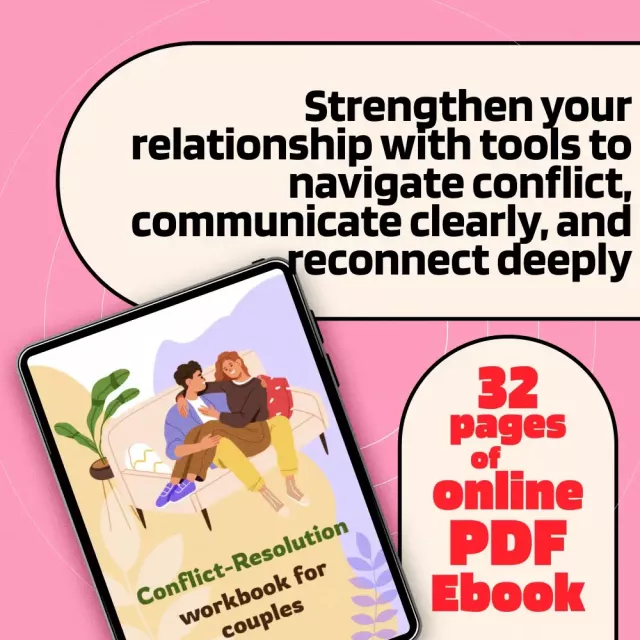
Recurring arguments can make even small issues feel high-stakes. A printable conflict-resolution workbook gives couples a clear, repeatable process: slow the conversation down, identify what’s really being asked for, and repair after misunderstandings. The goal isn’t to “win” an argument—it’s to understand each other, make workable agreements, and rebuild trust through consistent follow-through.
Most couples don’t fight because they “don’t care.” They fight because the same pattern hijacks the conversation before either person feels safe enough to be honest and flexible.
When the body is stressed, the brain narrows its focus and becomes more reactive—one reason “small” conflicts can feel urgent in the moment. The American Psychological Association summarizes how stress can affect behavior and decision-making in everyday life (APA: Stress effects on the body and behavior).
A guided workbook turns conflict into a shared routine instead of a free-for-all. With prompts on paper, the conversation slows down enough for both people to feel understood—and for agreements to become specific.
Think of this as a repeatable “protocol” for hard conversations—especially when you’re tired, stressed, or already irritated.
| Moment | What to say | What to avoid |
|---|---|---|
| Before talking | “Can we talk about this at 7:30 after we’ve cooled down?” | Starting mid-spiral or demanding an immediate resolution |
| During listening | “Let me repeat what I heard so you feel understood.” | Rebutting, correcting details, or preparing counterarguments |
| When emotions rise | “I’m getting flooded; I need a 20-minute break and I will come back.” | Storming out without a return time |
| When proposing change | “My request is ___, starting ___.” | “You never…” or “You always…” |
| After agreement | “Let’s check in on Friday to see how this is going.” | Assuming one conversation fixes a long-standing pattern |
When conversations go sideways, it’s often less about “what happened” and more about whether each person felt respected while talking about it.
For a helpful framework on destructive conflict habits (and what to do instead), see the Gottman Institute’s overview of “The Four Horsemen” and their antidotes (Gottman Method: The Four Horsemen and Their Antidotes).
If you’re unsure whether a relationship dynamic crosses into abuse, consult clear warning signs from the National Domestic Violence Hotline (Relationship abuse warning signs).
Aim for 20–40 minutes with a clear endpoint. If either person feels flooded, take a 20–30 minute break and schedule a follow-up instead of forcing a “finish” while escalated.
Yes—written prompts, timed turns, and a pre-agreed break/return rule reduce pressure and make participation feel safer. Start with low-stakes topics to build trust in the process before using it for bigger issues.
Therapy is the better choice when there’s persistent contempt, repeated boundary violations, intimidation, or conversations that feel unsafe or unproductive. Professional support can also help when trauma, addiction, or long-standing trust injuries keep overriding good intentions.












Leave a comment