
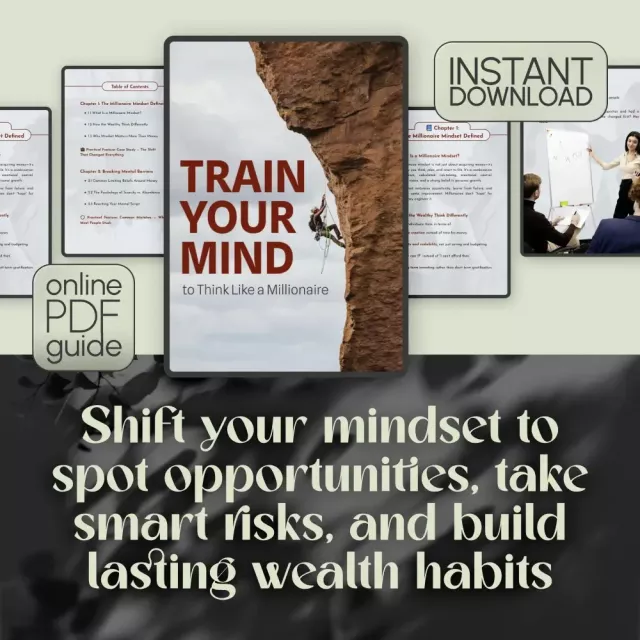
A millionaire mindset is less about quick wins and more about repeatable habits: clearer decisions, stronger boundaries, and a healthier relationship with money. When your thinking gets more structured, your actions get more consistent—and that’s where momentum comes from. The Train Your Mind to Think Like a Millionaire (Digital Download PDF eBook) combines guided exercises, planning pages, and reflection layouts designed to help build abundance-focused thinking, reduce self-sabotage, and turn goals into steady follow-through.
“Millionaire thinking” often sounds like a big, dramatic transformation. In real life, it tends to look quieter—small decisions repeated with intention. Day to day, it usually means:
Behavioral economics research highlights why this works: humans don’t make decisions purely rationally, especially around money. We’re influenced by stress, context, and mental shortcuts—so creating routines and decision rules matters. For a deeper overview, see the Stanford Encyclopedia of Philosophy entry on behavioral economics and the Nobel Prize summary of Richard Thaler’s contributions to integrating psychology and economics (Nobel Prize: Richard H. Thaler).
This workbook is designed to be used, not just read. The pages guide you through a practical loop: identify what’s holding you back, plan a small set of actions, then review results without perfectionism.
If stress has been shaping financial choices—impulse buys, avoidance, or “freeze” decision-making—adding structure can help. The American Psychological Association notes that stress affects both the body and behavior, which can spill into money habits and follow-through (APA: Stress effects on the body).
Consistency beats intensity for mindset work. A clean two-week sprint keeps the workload light while still creating measurable traction.
| Moment | Old reflex | Millionaire-minded reframe | Next action |
|---|---|---|---|
| Seeing a higher price | “That’s too expensive” | “Is this worth it for my goals?” | Compare alternatives and decide with criteria |
| Unexpected bill | “I’m always behind” | “This is a planning problem, not a character flaw” | Update budget and choose one offset |
| Opportunity to learn | “I’m not ready” | “Skills buy options” | Schedule one training block and apply it |
| Asking for a raise/price | “They’ll say no” | “Value deserves a clear ask” | Prepare evidence and make the request |
It’s a digital download PDF eBook/workbook, so nothing is shipped. You can print the pages you want or use a tablet/phone with a PDF annotation app.
Some shifts feel immediate, but measurable behavior change usually shows up over weeks as you practice consistently. Using short daily check-ins plus a weekly review helps you notice patterns and keep improving.
No—this focuses on beliefs, habits, planning, and reflection, so it’s beginner-friendly. You can pair it with simple budgeting or investing basics if you want more financial education alongside the mindset work.












Leave a comment