
HomeBlogBlogMillionaire Mindset Workbook: 14-Day Money Reset

Millionaire Mindset Workbook: 14-Day Money Reset

Millionaire Mindset Workbook: 14-Day Money Reset

Train Your Mind to Think Like a Millionaire: A Practical Mindset Workbook You Can Start Today

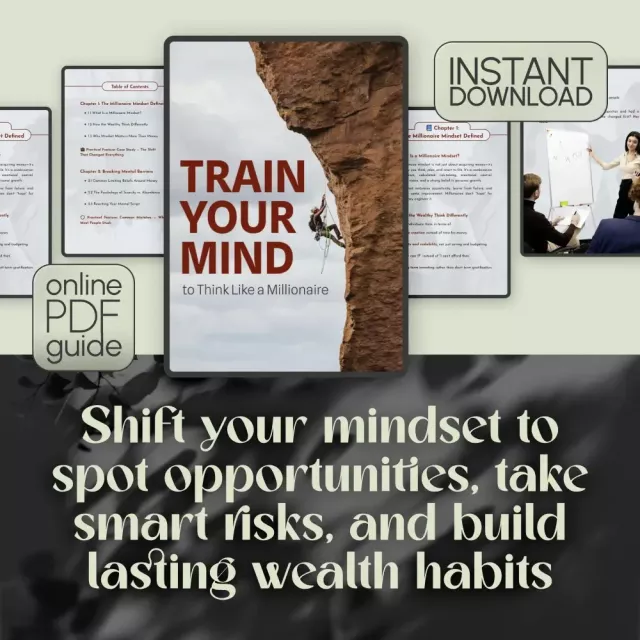
A millionaire mindset is less about quick wins and more about repeatable habits: clearer decisions, stronger boundaries, and a healthier relationship with money. When your thinking gets more structured, your actions get more consistent—and that’s where momentum comes from. The Train Your Mind to Think Like a Millionaire (Digital Download PDF eBook) combines guided exercises, planning pages, and reflection layouts designed to help build abundance-focused thinking, reduce self-sabotage, and turn goals into steady follow-through.

What “thinking like a millionaire” looks like day to day

“Millionaire thinking” often sounds like a big, dramatic transformation. In real life, it tends to look quieter—small decisions repeated with intention. Day to day, it usually means:

  • Choosing long-term value over short-term comfort, even in small purchases and time decisions. This is the difference between buying what’s cheapest and buying what holds up, or saying “yes” to a short-term distraction versus protecting a learning block.
  • Tracking outcomes and adjusting behavior instead of relying on motivation. If a plan isn’t working, the response is to refine the system—not to shame yourself.
  • Separating identity from income: mistakes become data, not proof of failure. This reduces emotional spending and avoidance because your self-worth isn’t on trial.
  • Building skills and systems (budgeting, investing basics, sales, communication) rather than chasing hacks. Over time, skills create options and options create leverage.

Behavioral economics research highlights why this works: humans don’t make decisions purely rationally, especially around money. We’re influenced by stress, context, and mental shortcuts—so creating routines and decision rules matters. For a deeper overview, see the Stanford Encyclopedia of Philosophy entry on behavioral economics and the Nobel Prize summary of Richard Thaler’s contributions to integrating psychology and economics (Nobel Prize: Richard H. Thaler).

What’s inside the digital workbook and how it supports change

This workbook is designed to be used, not just read. The pages guide you through a practical loop: identify what’s holding you back, plan a small set of actions, then review results without perfectionism.

  • Mindset reset prompts that surface limiting beliefs (scarcity thinking, fear of earning, guilt about wanting more).
  • Money clarity pages for goals, priorities, and “why” statements that stay stable when motivation dips.
  • Planning layouts that turn big goals into weekly actions and small, trackable milestones.
  • Reflection pages to review decisions, spot patterns, and reinforce progress without all-or-nothing thinking.
  • Printable PDF format for writing by hand or using a tablet annotation app.

If stress has been shaping financial choices—impulse buys, avoidance, or “freeze” decision-making—adding structure can help. The American Psychological Association notes that stress affects both the body and behavior, which can spill into money habits and follow-through (APA: Stress effects on the body).

A simple 14-day routine using the planner pages

Consistency beats intensity for mindset work. A clean two-week sprint keeps the workload light while still creating measurable traction.

  • Days 1–3: Define a money vision, identify top obstacles, and pick one focus area (earning more, saving, debt payoff, or spending boundaries).
  • Days 4–7: Track triggers (impulse spending, avoidance, undercharging, procrastination) and write replacement responses.
  • Days 8–11: Build a weekly action plan with 3 priorities and one measurable daily habit.
  • Days 12–14: Review results, choose what to keep, and set the next 2-week sprint.
  • Keep sessions short: 10–20 minutes is enough when done consistently.

Mindset shift examples to practice during the week

Mindset shift examples to practice during the week

Moment Old reflex Millionaire-minded reframe Next action
Seeing a higher price “That’s too expensive” “Is this worth it for my goals?” Compare alternatives and decide with criteria
Unexpected bill “I’m always behind” “This is a planning problem, not a character flaw” Update budget and choose one offset
Opportunity to learn “I’m not ready” “Skills buy options” Schedule one training block and apply it
Asking for a raise/price “They’ll say no” “Value deserves a clear ask” Prepare evidence and make the request

Money mindset themes the exercises target

  • Scarcity vs. abundance: shifting from fear-based choices to values-based choices.
  • Delayed gratification: reinforcing patience with visible progress markers.
  • Self-trust: reducing second-guessing by planning decisions in advance.
  • Resilience: recovering faster after setbacks and returning to the plan.
  • Responsibility without shame: owning outcomes while staying constructive.

Who this workbook fits best

Tips for getting the most from a digital download PDF

Common misconceptions that slow progress

Suggested picks to support a “value-first” lifestyle

FAQ

Is this a printable workbook or a physical book shipped to my home?

It’s a digital download PDF eBook/workbook, so nothing is shipped. You can print the pages you want or use a tablet/phone with a PDF annotation app.

How long does it take to see results from mindset work?

Some shifts feel immediate, but measurable behavior change usually shows up over weeks as you practice consistently. Using short daily check-ins plus a weekly review helps you notice patterns and keep improving.

Do I need advanced finance knowledge to use the planner?

No—this focuses on beliefs, habits, planning, and reflection, so it’s beginner-friendly. You can pair it with simple budgeting or investing basics if you want more financial education alongside the mindset work.

Was this article helpful?

Yes No
Leave a comment
Top

Shopping cart

×