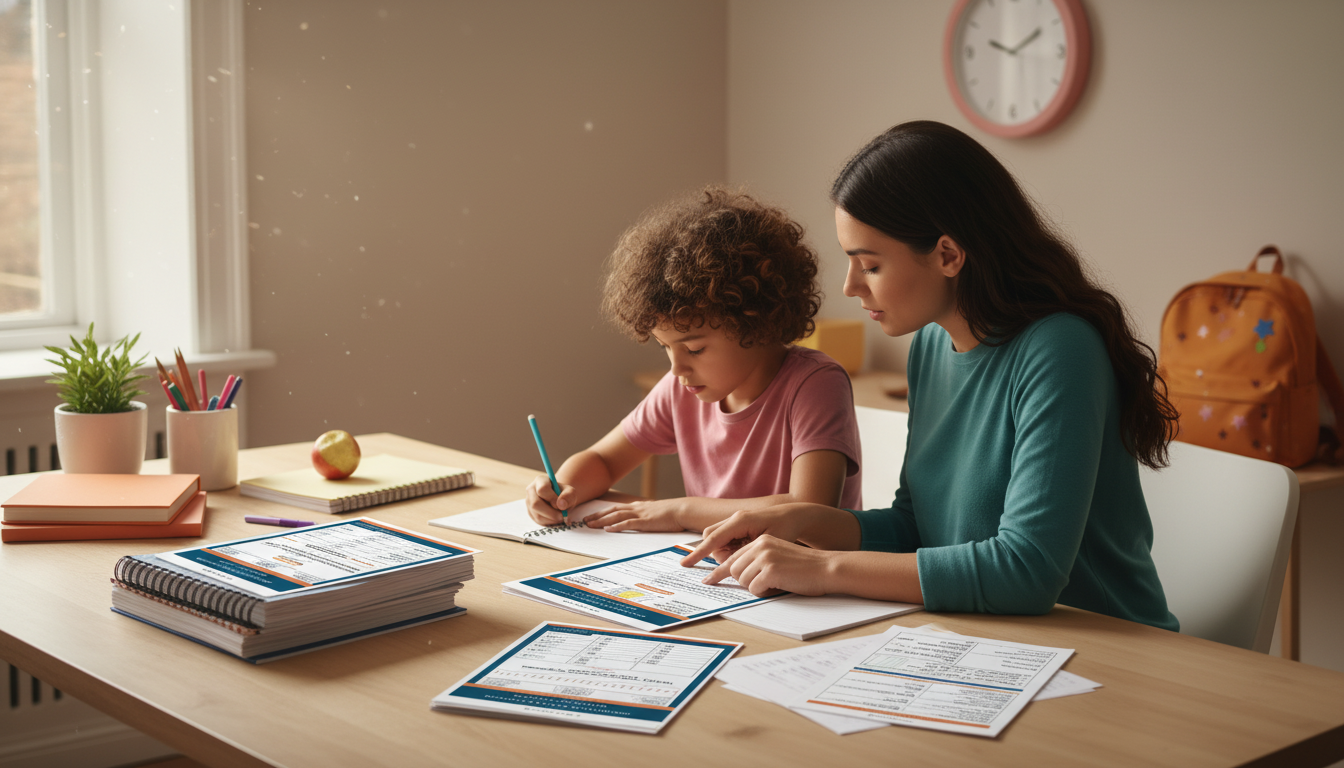
Homework can feel calmer—and far more productive—when routines, expectations, and support stay consistent. A simple toolkit of printable plans, checklists, and short “say-this” scripts helps reduce daily friction, teach organization, and gradually shift responsibility to the child without turning evenings into a power struggle. The goal isn’t perfect homework; it’s steady habits that grow confidence over time.
Effective homework help looks more like coaching than rescuing. When adults step in to “fix” hard parts, kids lose the chance to practice the exact skills that make homework easier next week.
For a science-backed view of building responsibility and study behaviors, the American Psychological Association emphasizes consistent routines and gradual independence as key ingredients.
A “homework zone” doesn’t need to be Pinterest-perfect. It needs to be predictable. When the setup stays the same, your child spends less mental energy searching for materials and more energy getting started.
If evenings melt down more when kids are overtired, check the CDC’s age-based sleep guidance and consider shifting homework earlier where possible: How much sleep do children need?
When motivation is low, a simple loop reduces decision fatigue. Keep the language consistent so it becomes automatic.
| Routine style | Best for | Example flow | Parent role |
|---|---|---|---|
| Snack-first | Kids who arrive hungry and irritable | Snack (10 min) → Homework sprint (20 min) → Break (5 min) → Sprint (20 min) | Set timer, start-up check, brief mid-point glance |
| Movement-first | High-energy kids who struggle to sit right away | Outside/play (20–30 min) → Homework (30–45 min) → Pack/close | Hold the boundary on start time; praise starting |
| Homework-first | Kids who do best before fatigue | Homework (30–60 min) → Free time → Dinner | Keep help minimal; reinforce independence |
| Split-load | Kids with long assignments or multiple activities | Short homework block (20–30 min) → Activity → Second block (15–25 min) | Help with planning and prioritizing |
Study habits are learned behaviors. Over time, kids can manage their own learning with systems that reduce “I forgot” moments and make practice more effective. The OECD describes this as self-regulated learning—students planning, monitoring, and reflecting on their work: What is self-regulated learning?
It varies by school and grade, but a common guideline is roughly 10 minutes per grade level (for example, about 30 minutes in 3rd grade). Track actual time for 1–2 weeks; if it’s consistently excessive or stressful, contact the teacher to clarify expectations and adjust the plan.
Help by setting the routine, clarifying directions, and asking guiding questions that point to the next step. Use a help ladder (try alone → check notes → ask teacher/peer → ask parent) and focus your “check” on completion and following directions rather than supplying answers.
Keep the start predictable with a short ritual, offer structured choices (which task first), and set a tiny first step with a brief timed attempt (5 minutes). If refusal is frequent, consider contributing factors like hunger, lack of sleep, or overwhelm, and adjust the schedule or task size before escalating consequences.












Leave a comment